
You've found a funder that looks like a serious fit. The program area aligns. The timing works. The project is strong. Then the instructions say they want a letter of inquiry first.
That's the moment many researchers lose momentum. The LOI looks short enough to handle later, yet high stakes enough to feel dangerous. Teams start treating it like an administrative pre-step, something to compress from an old proposal abstract and send off quickly.
That's usually the wrong move.
A strong letter of inquiry for grants does something much harder than a full proposal. It persuades a funder to keep reading when you have almost no space, no appendices, and no room for drift. It has to show need, fit, feasibility, and judgment all at once. For AI, health, and interdisciplinary work, it also has to reduce perceived risk before a reviewer ever asks for more.
Table of Contents
- Why Your Letter of Inquiry Is More Than Just a Formality
- Anatomy of a Winning Letter of Inquiry
- Drafting Each Section With Sample Language
- Customizing Your Pitch for NSF, NIH, and Horizon Europe
- Common LOI Mistakes That Lead to Rejection
- Your Pre-Submission Review Checklist and Timeline
Why Your Letter of Inquiry Is More Than Just a Formality
Most applicants know the LOI is important. Fewer act like it is.
The fastest way to improve your odds is to stop thinking of the LOI as a miniature proposal. It isn't. It's a conversation starter with a gatekeeper. The funder is deciding whether your project sounds aligned, credible, and manageable enough to justify a second interaction.
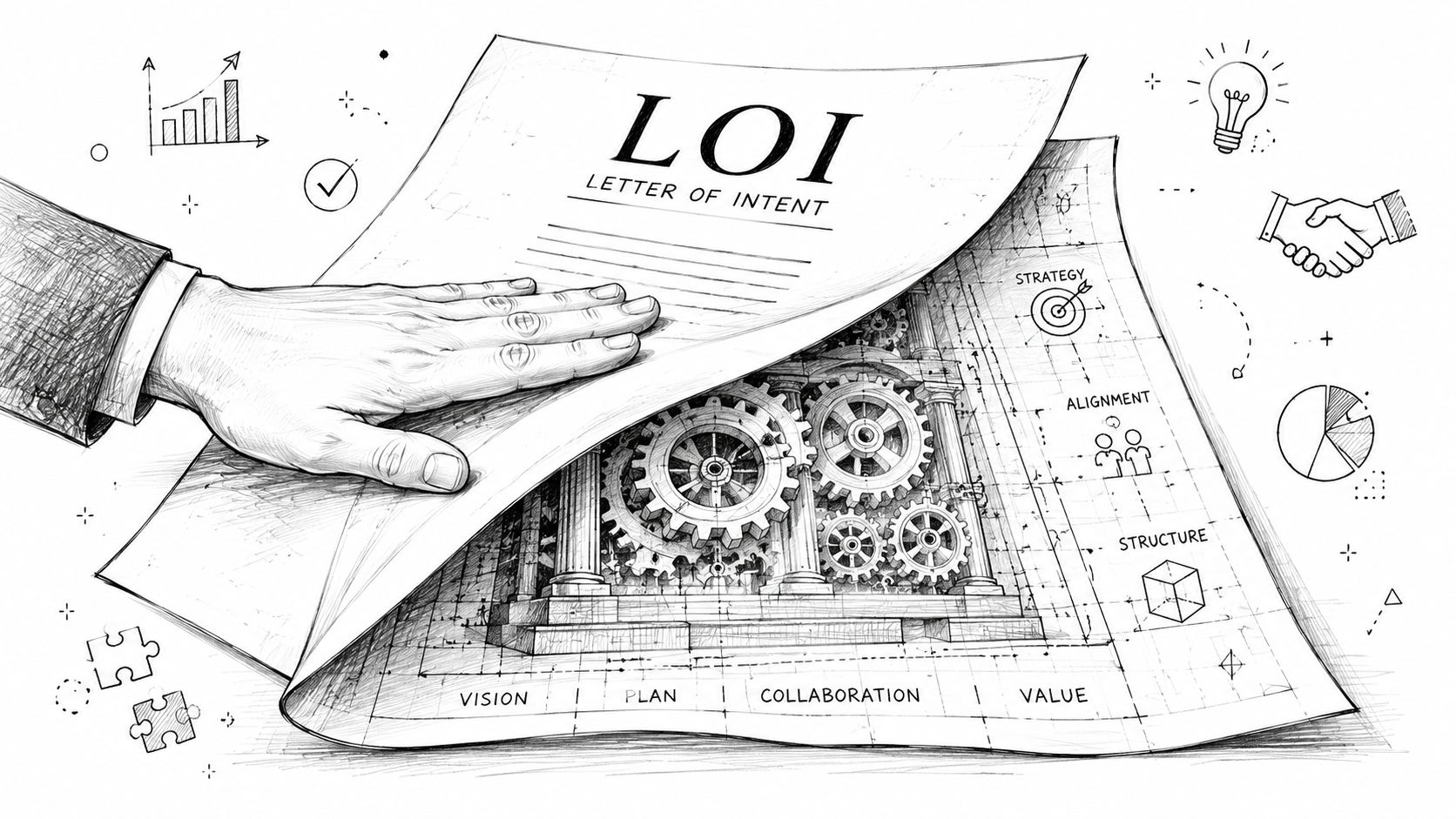
That changes how you write it. You're not trying to prove everything. You're trying to make the reviewer comfortable advancing you. That means your LOI needs to answer four silent questions quickly:
- Why this problem
- Why this approach
- Why your team
- Why this funder
Guidance gathered in Fundsprout's overview of letters of inquiry makes this plain. Most funders want LOIs in the 1 to 3 page range, with 2 pages often treated as the sweet spot, and strong guidance from Candid and Northwestern shows the letter still needs concrete elements such as the organization name, amount requested, project description, staff qualifications, evaluation approach, and a timeline. That's not a casual note. It's a compressed investment case.
Practical rule: If your LOI reads like a placeholder for the “real proposal,” the reviewer will treat your project like a placeholder too.
I've seen excellent projects stall because the LOI sounded vague, overstuffed, or strangely generic. The science was solid. The signal was weak. Reviewers didn't reject the idea so much as decline to spend more time decoding it.
A good LOI respects the reviewer's workload. It gets to the point early, frames the opportunity cleanly, and gives enough operational detail to show you can execute without drowning the reader in process.
Anatomy of a Winning Letter of Inquiry
A reviewer opens your LOI between meetings, gives it a fast first read, and decides whether your project belongs in the next round. That decision usually happens before they reach the bottom of page one. Write for that moment.
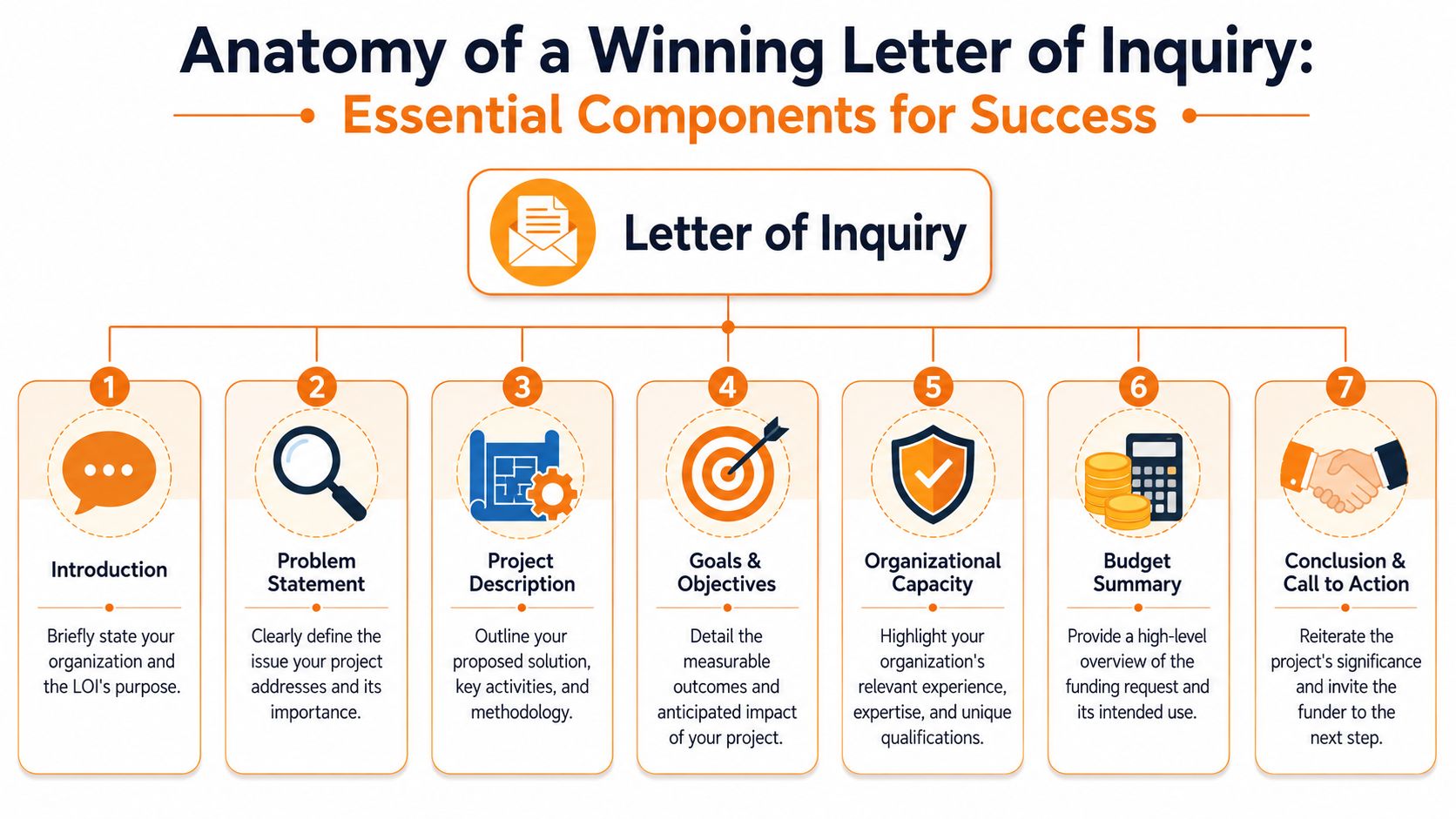
Read the LOI as a screening document
A strong LOI works as an early strategic conversation with the funder. It shows that you understand their priorities, that the project is shaped for their program, and that your team can execute without excessive risk. In research settings, especially for AI-related work, that last point carries extra weight. Reviewers often look for signs that the project is not just groundbreaking, but governable, feasible, and worth inviting forward.
That changes what belongs in the letter. Every section should reduce uncertainty.
The five moves that make the letter work
Open with the problem and the decision case
The first paragraph should tell the reviewer what matters, why now, and what you want them to do next. Skip institutional throat-clearing. A reviewer does not need your origin story before they understand the case for funding.
Weak opening:
“Our lab has long been committed to interdisciplinary innovation across several domains.”
Stronger opening:
“We seek support for a project addressing a defined implementation barrier in clinical AI deployment, with a study design and oversight plan aligned to your interest in safe, scalable research.”
That opening does more than sound sharper. It gives the reviewer a funding logic.
Make fit explicit
A common failure is assuming the fit is obvious. It usually is not, especially when the proposal sits near a boundary area such as AI, translational methods, public health infrastructure, or cross-sector data work. Reviewers may like the idea and still decline it if the portfolio match is unclear.
State the alignment plainly. Name the specific program interest, challenge area, or call language your project addresses. Then show how your design choices support that fit. If your letter could be sent to three different funders with only the name changed, it is still too generic.
Show enough method to signal control
The LOI is not the place for a full protocol. It is the place to prove that the project has been thought through. Briefly cover the population or setting, the intervention or research activity, the implementation path, and how progress will be assessed.
For AI proposals, I advise teams to include one sentence that signals technical and ethical control. Mention data provenance, model evaluation in the intended setting, oversight, or bias monitoring if those issues are central to the project. Funders do not need a long responsible-AI lecture. They do need evidence that the team sees the operational risks early.
Prove capacity with relevant evidence
Capacity is not a mini-CV. It is the shortest possible case that this team can deliver the work. Mention the project lead, the expertise that matters for this specific project, and any asset that lowers execution risk, such as patient access, a validated dataset, embedded clinical partners, regulatory experience, or prior delivery of a similar program.
Be selective. A Nobel-level credential that has little to do with the work is less persuasive than a sentence showing the team has already recruited the target population or deployed the underlying system in practice.
If you want a practical format to compare against your own draft, review these grant letter examples and templates.
End with a specific ask
Weak LOIs often fade out in the last paragraph. The writer gets polite, broad, and indirect. That costs momentum. Close with the amount requested if the funder expects it, the purpose of the funding, and a clear statement that you welcome the opportunity to submit a full proposal or discuss fit.
A good closing leaves no ambiguity about the next step.
A practical anatomy often looks like this:
| Component | What the reviewer needs | What weak drafts do |
|---|---|---|
| Opening | A defined problem, urgency, and project direction | Start with mission boilerplate |
| Project summary | A plausible approach in plain language | Drift into jargon or abstract ambition |
| Funder fit | Clear alignment with program priorities | Assume alignment will be inferred |
| Capacity | Evidence this team can deliver | List credentials without relevance |
| Budget and close | A direct ask and next step | End politely but vaguely |
The trade-off is always compression. You are fitting significance, feasibility, and fit into a short document. The best LOIs accept that constraint and use it well. They do not try to say everything. They make it easy for a reviewer to say yes to the conversation.
Drafting Each Section With Sample Language
Most LOIs don't fail because the writer lacks expertise. They fail because expertise shows up as density, abstraction, or recycled text. Michigan Tech's guidance on writing a letter of inquiry is especially useful here: competitive LOIs need concision and evidence density, and a common pitfall is reusing language from other applications instead of tailoring every sentence to the funder and the space available.
If you're staring at a blank page, start by drafting badly on purpose. Then revise for force.
For a set of editable examples and formats, it can help to compare your draft against a dedicated grant letter resource.
The opening problem statement
Before
We are pleased to submit this letter regarding our forward-thinking project in digital health, which aims to address several important issues affecting patients and providers.
After
“Our project addresses a clear implementation gap in digital health delivery for a defined patient group. We are requesting support to test a focused, feasible response that matches your interest in scalable, practice-ready research.”
Why the revision works:
- It identifies a specific kind of problem
- It signals an ask
- It introduces fit
- It removes filler like “pleased to submit”
The reviewer doesn't need gratitude in the first line. The reviewer needs orientation.
The project description and method
Before
“The project will use advanced methods and interdisciplinary collaboration to generate insights and improve outcomes through a robust work plan.”
After
“We will implement a structured work plan that combines data collection, model development, and field-informed evaluation. The project is designed for real-world use, with activities sequenced to produce an early implementation signal as well as actionable findings.”
Why this lands better:
The revision shows movement. It tells the reviewer what the team will specifically do, and it hints at evaluation without pretending this short letter can carry full protocol detail.
A good middle paragraph usually answers these questions in compact form:
- Who is the project for
- What will happen first
- What makes the approach credible
- How you'll know whether it is working
The team, budget, and close
Before
“Our team is uniquely qualified and has substantial experience in the field. We hope the foundation will consider supporting this important initiative.”
After
“The project will be led by a team with direct expertise in the research area, implementation environment, and evaluation approach. We request support for the proposed scope of work and would welcome the opportunity to provide a full proposal with additional detail on design, timeline, and expected outcomes.”
Why the revised paragraph is stronger:
- It connects qualifications to the project instead of making a generic claim
- It includes an explicit request
- It gives the funder a natural next step
Here's another pair that shows the difference between generic and funder-specific writing.
Before
“This work aligns with your goals around innovation and impact.”
After
“This project aligns with your interest in research that moves beyond concept development into practical adoption, with a clear plan for implementation and assessment.”
The second version still stays broad, but it sounds like the writer has read the program language and understands what kind of impact matters to that funder.
A few drafting habits help more than people expect:
- Cut throat-clearing phrases. Delete “we are pleased,” “this exciting initiative,” and “in today's world.”
- Replace adjectives with nouns and verbs. “Novel” means little. “Implement,” “evaluate,” and “deploy” mean more.
- Name the target setting. A reviewer trusts a project more when they can place it.
- Leave room for the reviewer to want more. An LOI should create confidence, not exhaust the topic.
One last editing trick: read every paragraph and ask whether it earns its place. In an LOI, every sentence competes for survival. If a sentence doesn't show need, fit, method, capacity, or the ask, it probably doesn't belong.
Customizing Your Pitch for NSF, NIH, and Horizon Europe
A generic LOI can sound competent and still go nowhere. Different funders don't just support different topics. They reward different kinds of framing.
If you're writing one core letter and swapping names, stop. The sharper move is to hold the project constant and change the emphasis.
What changes across funders
For NSF, the LOI usually needs to show intellectual seriousness and a credible path to broader value. That doesn't mean stuffing in every conceptual nuance from the science. It means showing that the work matters beyond your immediate subfield and that you can articulate who benefits from the research ecosystem around it.
For NIH, public health relevance has to be legible early. Even highly technical work benefits from a clear line between the research activity and the health problem it addresses. If that line appears only in the final paragraph, the LOI is doing unnecessary damage to itself.
For Horizon Europe, reviewers often expect stronger framing around consortium logic, implementation feasibility, policy relevance, and what many teams call European added value. The project has to sound like something that belongs in a coordinated transnational funding environment, not a local pilot with European labels attached.
Here's a practical comparison:
| Funder | Primary Focus | Key Element to Emphasize | Common Mistake |
|---|---|---|---|
| NSF | Research merit and broader value | Why the work matters beyond the immediate study | Writing only for narrow specialists |
| NIH | Relevance to health and translational importance | Clear link to a health need or care problem | Leading with technical detail before clinical or public significance |
| Horizon Europe | Collaborative impact and implementation context | Why the consortium and policy context matter | Treating it like a single-PI national grant |
For teams building EU-facing applications, this broader context matters when you shape early messaging. A funder-specific planning guide like this Horizon Europe 2026 guide can help you pressure-test whether your framing sounds national, institutional, or cross-border.
Where AI and data-sensitive projects need extra care
Many otherwise good LOIs still underperform in this regard.
Candid's AI-related discussion highlights an important shift. The EU AI Act entered into force in 2024 and begins phased application through 2025 to 2027, while the Stanford AI Index 2025 reports continued expansion in AI adoption and policy attention, creating new pressure on AI-enabled research to address responsible AI, data governance, privacy, and implementation feasibility early in the process, as summarized in Candid's guidance on what to include in letters of inquiry. Most LOI advice still doesn't tell applicants how to preview those issues in a brief letter.
That gap matters most in AI, health, and interdisciplinary proposals. If your LOI says “AI-enabled platform” but says nothing about governance, privacy, or oversight, the project can sound immature even when the technical work is strong.
A better approach is to include a small but reassuring signal. Not a full ethics appendix. Just enough to show that the team has thought operationally about risk.
For example, instead of:
“We will use AI tools to improve decision support.”
Try:
“The project includes a defined governance approach for data use, oversight, and evaluation so that technical performance and responsible deployment are addressed together.”
That sentence calms a reviewer down. It tells them the team isn't treating implementation risk as an afterthought.
Common LOI Mistakes That Lead to Rejection
A program officer opens your LOI between meetings. In two minutes, they need to answer three questions. What is this project, why does it matter to this funder, and can this team execute it? If the letter makes any of those answers hard to find, the file usually stops there.
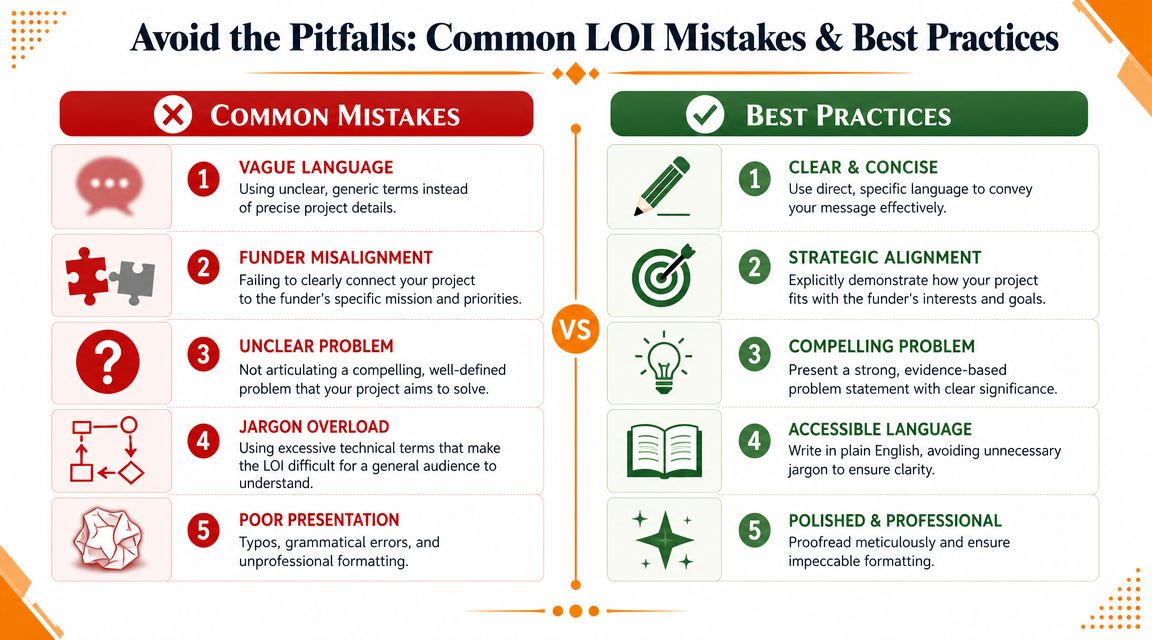
Reviewers are not looking for polish alone. They are screening for judgment. A strong LOI gives them the basic operational pieces they need to advance the project: the problem, who is doing the work, why the project fits this funder, what will be done, and what level of support you are requesting. If one of those pieces is missing, the letter can read like an interesting concept instead of a fundable opportunity.
That distinction matters even more for fast-moving areas such as AI, translational health, and cross-sector research. In those fields, a vague LOI can signal more than weak writing. It can suggest the team has not yet turned a promising idea into a manageable project.
Mistakes reviewers notice immediately
The ask is fuzzy
A surprising number of letters describe the work but never make a clear request. They hint at interest, summarize the science, and close with thanks. The reviewer is left to infer the amount, purpose, or next step.
State the ask directly. If you are seeking an invitation to submit a full proposal for a pilot study, say that. If the request is for planning support before a larger implementation phase, say that too.
The significance shows up too late
Writers who know their field well often save the clearest explanation for paragraph three or four. By then, the reviewer has already formed an impression.
Lead with the pressure point. What problem is unresolved, for whom, and why now? In AI-related projects, that often means pairing the technical promise with the implementation reality. A letter that says “AI-enabled decision support” but delays any mention of clinical workflow, oversight, or data governance can lose confidence early.
The fit is asserted, not demonstrated
“Strong alignment with your mission” is filler unless it is followed by proof. Funders want to see that you understand how they frame the problem, what populations or systems they care about, and what kinds of projects they tend to advance.
The trade-off here is real. If you over-customize, the LOI can sound artificial. If you stay generic, it sounds recycled. The right move is one or two precise sentences that connect your project to the funder's stated priorities without parroting their website.
The method section tries to do too much
Some LOIs fail because they are thin. Others fail because they read like a compressed full proposal. Reviewers do not need every analytic detail at this stage. They need enough to believe the work is scoped, sequenced, and feasible.
I usually tell teams to answer four practical questions: what will be built or studied, with whom, over what period, and how success will be judged. For AI proposals, add one more. Who is responsible for oversight when model performance, privacy, or deployment risk becomes an issue?
The letter confuses expertise with capacity
A long list of publications or institutional strengths does not answer the reviewer's real question: can this team deliver this project as proposed? Capacity is specific. It includes access to the right data, implementation partners, regulatory or ethics support, and a staffing plan that matches the scope.
Here's a short video that captures several of these review-stage issues in a practical way.
How to fix a weak draft before it goes out
A good red-team review looks for friction, not grammar alone.
From abstract to concrete
Replace “novel platform” with a plain description of what the platform does in this project and who will use it.From mission statement to funder fit
Replace broad value language with one sentence that ties the project to the funder's actual program priorities.From credentials to delivery
Replace general claims about experience with the specific assets that make this team ready now.From technical density to decision-ready clarity
Keep enough methodological detail to show control. Cut anything that forces a first-stage reviewer to decode your expertise.
A reviewer rarely says, “This letter needed more adjectives.” They do say, “I'm not convinced this team knows how to position the work.”
Another common failure point is document discipline. Teams ignore page limits, add material the funder did not request, paste in boilerplate from an old application, or leave unresolved inconsistencies between the budget ask and the scope. Those errors are fixable, but they create doubt about how the team will handle a full award.
Before submission, run one final pass with a practical research application submission checklist. Then ask the question that catches most weak LOIs: could a busy program officer explain your project and your ask to a colleague after one read? If the answer is no, revise again.
Your Pre-Submission Review Checklist and Timeline
The calmest submissions come from teams that treat the LOI like a managed process, not a last-minute writing task.
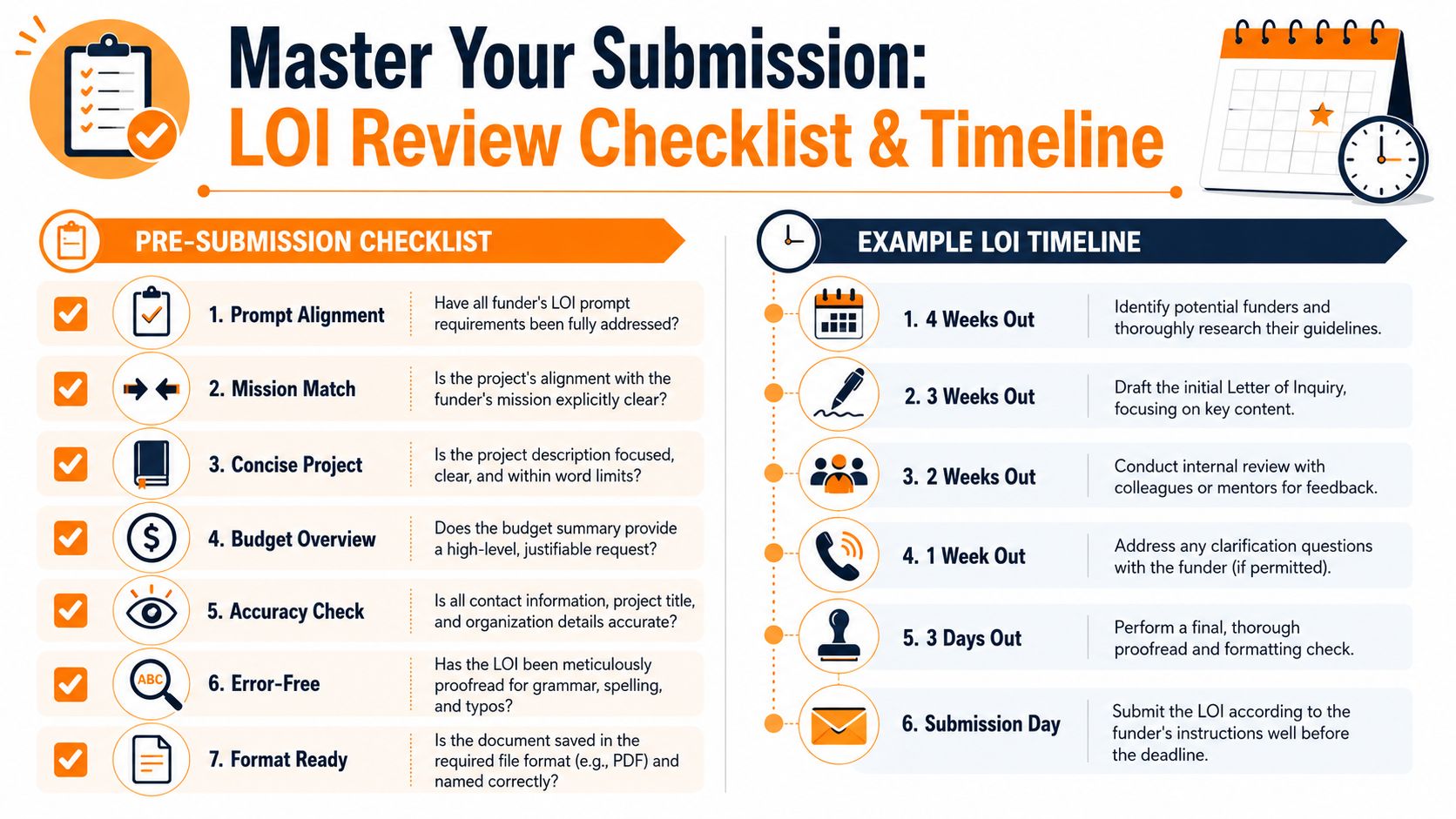
A practical final review checklist
Before sending any letter of inquiry for grants, check these points:
- Prompt alignment. Every requested element is present, and nothing extra has been inserted without a reason.
- Mission match. The fit is explicit, not implied.
- Problem clarity. The first paragraph makes the need and significance easy to grasp.
- Execution signal. The method, staffing, and timeline feel controlled.
- Budget discipline. The request is clear and framed as part of a credible scope of work.
- Tone control. The language is direct, specific, and free of recycled proposal padding.
- Submission hygiene. File name, format, and contact details are correct.
For a final pass before deadline, a dedicated submission checklist for research applications can help teams catch avoidable misses.
A simple work-back timeline
A basic work-back schedule keeps the pressure manageable:
| When | Focus |
|---|---|
| 4 weeks out | Review the call, funder language, and internal go or no-go decision |
| 3 weeks out | Draft the core argument and gather missing project details |
| 2 weeks out | Get feedback from a colleague who will challenge clarity, not just content |
| 1 week out | Tighten language, confirm compliance, and resolve open questions |
| Final days | Proofread, format, and submit early if the portal allows |
The timeline matters less than the sequence. Good LOIs usually improve in the revision step where someone asks, “What is the actual ask, and why this funder?”
If you want help turning scattered project notes, prior proposals, and call documents into a sharper LOI or full submission package, PROPOSIA is built for that workflow. It helps research teams analyze funder requirements, refine scope, draft specific sections, and run a red-team review before submission, while keeping sensitive research materials protected.