
Your research office has probably run some version of the same workshop for years. A broad session called “Grant Writing 101.” A slide deck on persuasive language. A short Q&A at the end. People leave with notes, but not with a sharper process, a cleaner draft workflow, or a better grasp of what will cause an application to fail.
That model breaks because grant proposal writing training is not a generic writing problem. It's a production problem, a compliance problem, and a decision-making problem. Researchers need to learn how to interpret funding calls, control scope, gather evidence, route drafts, manage attachments, and survive review. Trainers need a program architecture that reflects that reality.
For research administrators and PIs who run internal workshops, the job is not to “teach grant writing” in the abstract. The job is to build a repeatable training system that changes proposal behavior. That means audience segmentation, funder-specific drills, iterative critique, and modern tool use with clear guardrails.
Table of Contents
- Why Most Grant Writing Training Fails And How to Build One That Succeeds
- Before the Curriculum Defining Your Training Goals
- Building Your Core Grant Writing Curriculum
- From Theory to Practice Hands-On Grant Writing Exercises
- Funder-Specific Training for NIH NSF ERC and Horizon Europe
- Integrating AI and Tools Like Proposia into Grant Training
- How to Measure the ROI of Your Grant Training
Why Most Grant Writing Training Fails And How to Build One That Succeeds
Most grant workshops fail because they teach writing as if writing were the bottleneck. It usually isn't. Instead, the breakdown happens earlier, when teams choose weak opportunities, misread the call, underbuild the evidence base, or leave compliance work to the final days.
That mismatch matters because grant development is expensive in staff time. Instrumentl's grant statistics and trends analysis reports that a foundation grant may take 15 to 20 hours, while a typical federal grant can require over 100 hours, and average success rates are around 10%, roughly 1 accepted proposal out of 10. When the process is that demanding, a workshop that focuses only on writing style is training people for the wrong part of the job.
What generic workshops usually get wrong
A weak training design usually has three flaws:
- Mixed audiences: Early-career researchers, experienced PIs, and research administrators sit through the same session and need very different things.
- Abstract instruction: Trainers explain “be persuasive” without showing how to map evaluation criteria, build attachments, or manage revisions.
- No production discipline: Participants leave with concepts, not with templates, checklists, or a usable drafting sequence.
Practical rule: If a workshop can be delivered unchanged to a first-year doctoral student and a senior PI leading a multi-partner bid, it's too generic to improve proposal quality.
The better model treats grant proposal writing training as operational training. Participants should learn how a proposal moves from opportunity review to red-team edit, who owns each component, and what must be checked before submission. Good programs also address the unwritten norms that shape proposal decisions, such as reviewer tolerance for overreach, internal politics around authorship, and how much unstated institutional knowledge applicants are expected to have. That hidden layer is worth addressing directly, and this discussion of the hidden curriculum in grant writing is a useful framing device for trainers building sessions for faculty.
What effective programs do instead
Strong programs are narrower and more deliberate. They teach people to:
- Read the call like a reviewer
- Translate criteria into a writing plan
- Build evidence before drafting
- Use staged review cycles
- Separate compliance checks from narrative polish
That's what changes outcomes. Not a better lecture, but a better workflow.
Before the Curriculum Defining Your Training Goals
The quality of a training program is set before the first slide is built. If you don't define what the training must change, you'll end up with a session people enjoy and a pipeline that behaves exactly as it did before.
Start with proposal behavior not content volume
The first planning question isn't “What should we teach?” It's “What proposal behavior has to improve?” That changes everything.
A useful needs analysis looks at recent submissions and asks where they broke down. In most institutions, the same failure patterns recur:
- Opportunity fit problems: Teams pursue calls that don't match the project or the funder's priorities.
- Structure problems: Drafts don't clearly answer the scoring criteria.
- Evidence problems: Need, significance, or feasibility claims are asserted rather than supported.
- Workflow problems: Internal review starts too late, or no one owns final compliance checks.
- Submission problems: Attachments, validations, approvals, or system entries become a last-minute crisis.
You don't need a complicated instrument to surface this. A short intake form for faculty, a debrief with departmental administrators, and a review of recent internal comments often gives enough signal to design a useful curriculum.
Ask departments for examples of proposals that were strong scientifically but weak operationally. Those examples usually tell you more than satisfaction surveys ever will.
Training goals should then be written as observable skills. “Write better proposals” is too vague to drive a curriculum. Better goals sound like this:
- Participants can extract required elements from a funding call and map them to proposal sections
- Participants can draft a one-page concept note that shows fit, significance, and feasibility
- Participants can identify evidence gaps before full drafting begins
- Participants can run a structured peer review against published criteria
- Participants can prepare a submission-readiness checklist for a target funder
Segment the room before you design the session
Audience segmentation is where many internal programs go off course. A single workshop rarely serves everyone well.
Early-career researchers often need help with framing a fundable question, understanding common proposal components, and surviving first contact with sponsor language. Senior PIs usually need support with team coordination, scope control, institutional routing, and reviewer calibration. Research administrators need training that helps them coach others, catch compliance issues, and standardize process across units.
That means a train-the-trainer model should usually include at least three pathways:
| Audience | Primary Need | Best Training Focus |
|---|---|---|
| Early-career researchers | Proposal fundamentals and funder fit | Guided drafting, concept development, reviewer mindset |
| Established PIs | Competitive positioning and team execution | Scope control, strategic framing, internal review, funder-specific nuances |
| Research administrators and facilitators | Repeatable support methods | Checklists, workshop facilitation, workflow design, compliance mapping |
Choose a delivery format that matches the work
Format is a strategic choice, not a logistics detail. The wrong format can flatten a good curriculum.
| Factor | In-Person Training | Online Training (Live) | Online Training (Self-Paced) |
|---|---|---|---|
| Interaction quality | Strong for critique and discussion | Good if tightly facilitated | Limited unless paired with office hours |
| Best use case | Draft workshops, peer review, funder drills | Distributed teams, recurring clinics | Foundational concepts and onboarding |
| Trainer workload | Higher coordination and room management | Moderate, requires active moderation | High upfront build, lower delivery load |
| Participant accountability | Stronger social pressure to prepare | Good with assignments | Weak unless deadlines are enforced |
| Best for train-the-trainer programs | Excellent | Strong | Useful as a support layer, not the whole program |
A bootcamp works when you need momentum. A multi-session series works when participants are drafting real proposals. Self-paced modules work best for prerequisites, not for the full experience. Grant proposal writing training improves when people practice with live material, get critique, revise, and come back.
Building Your Core Grant Writing Curriculum
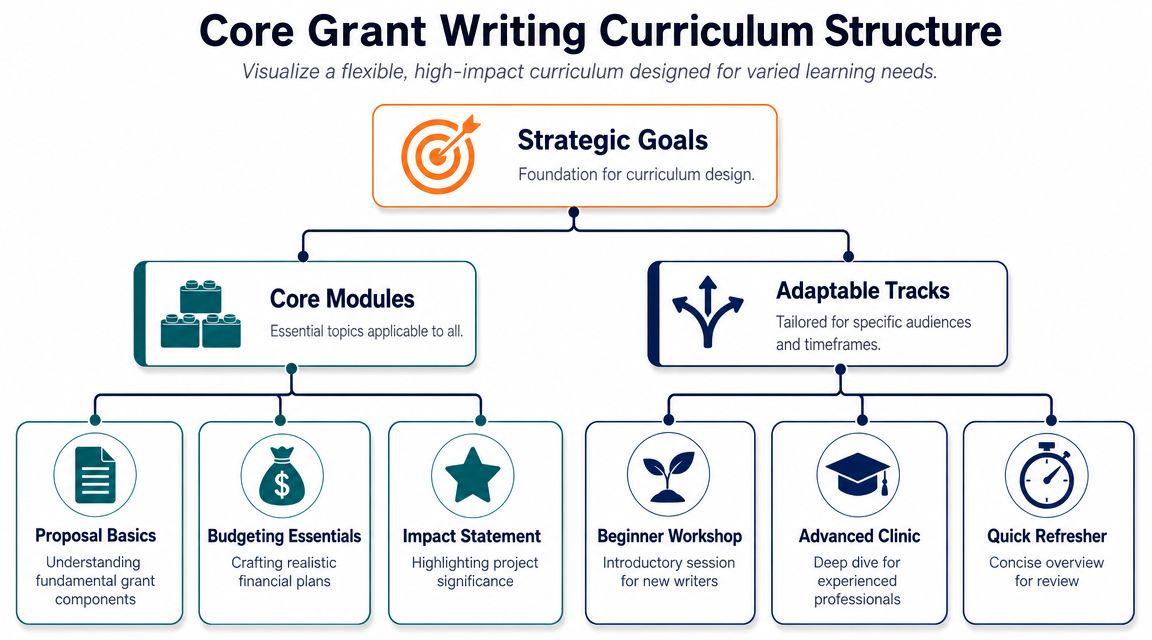
A durable curriculum is modular. It has a shared core that everyone needs, plus adaptable tracks for different funders, career stages, and proposal types.
The modules every program needs
The first module should teach reviewer mindset. Many applicants write from the inside out. They describe what interests them, not what the reviewer must quickly understand. Trainers should use anonymized excerpts and scoring rubrics to show how reviewers read for clarity, significance, feasibility, and fit under time pressure.
The second module is call deconstruction. Here, participants annotate a real funding opportunity and turn it into a requirement map. Strong trainers make people mark mandatory sections, hidden criteria, evaluation language, eligibility constraints, and required attachments. This is one of the highest-value drills in any grant proposal writing training program because it moves people away from generic proposal habits.
The third module is proposal architecture. Here the focus is not literary style. It's structure. Participants need to see how a proposal creates logic from problem to aims to methods to evaluation to impact. This is also where it helps to use a strong anatomy model such as this breakdown of a winning proposal anatomy, because it lets trainers show where common sections carry different strategic weight.
A fourth module should address budget and narrative alignment. Even when trainers are not finance specialists, they should teach participants that staffing, timeline, activities, and requested resources must tell the same story. A proposal loses credibility fast when ambitious work appears with thin operational support.
Teach evidence as an argument not decoration
Evidence is not the “supporting detail” section. It is the backbone of a credible proposal.
Guidance from Bloomerang on the grants writing formula emphasizes that strong proposals need research-backed need statements and measurable outcomes supported by statistics. That broader shift toward evidence-based funding has changed what trainers should teach. Participants need to learn how to define the problem with precision, justify the intervention, and set a baseline for later evaluation.
A practical curriculum module on evidence should include:
- Need statement design: What counts as persuasive evidence for the problem being addressed
- Baseline thinking: What the project can reasonably measure and why that matters
- Claim testing: Which sentences in a draft require support, qualification, or revision
- Evidence hierarchy: What to use when direct local data is thin and where institutional data can strengthen the case
Strong training doesn't tell participants to “add data.” It shows them which claims are currently unsupported and why a reviewer would distrust them.
A final core module should cover internal review discipline. Participants need to learn when to seek conceptual feedback, when to invite subject critique, and when to run a final compliance pass. Without that sequence, workshops produce better drafts but not better submissions.
From Theory to Practice Hands-On Grant Writing Exercises
The fastest way to expose weak grant habits is to make people do the work in the room. Lectures create recognition. Exercises create competence.
Run workshops like a proposal development sprint
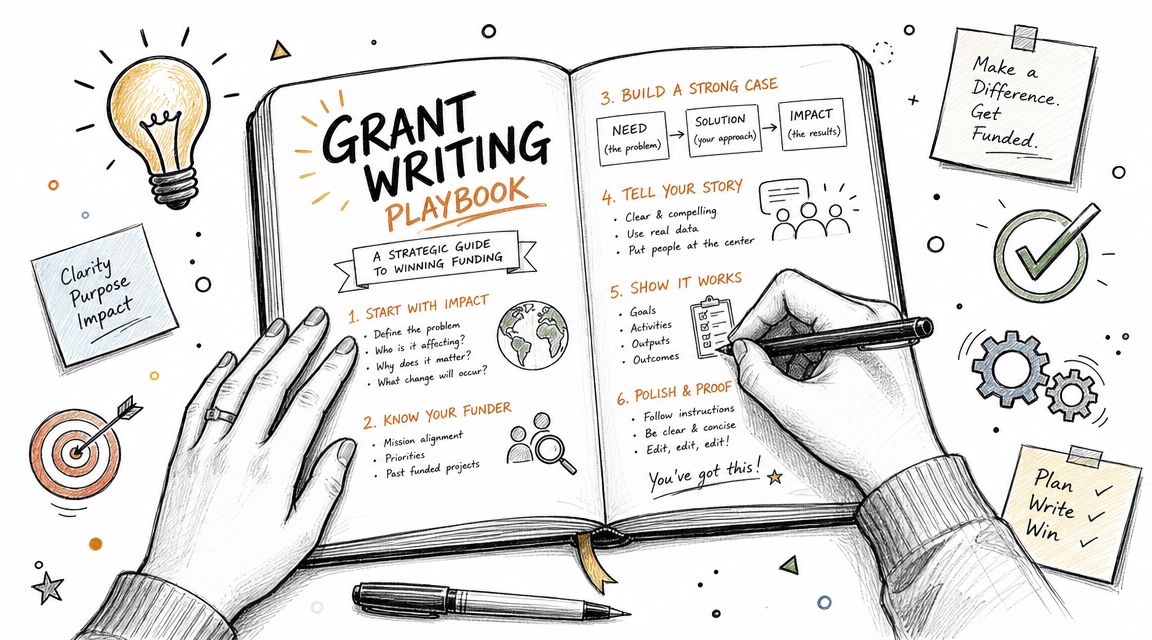
The most effective workshops behave more like a proposal studio than a seminar. Participants arrive with material. They work in timed blocks. They produce artifacts. They receive structured critique.
That design matches what the literature recommends. A peer-reviewed review of grant-writing strategies advises allocating substantial time to an iterative review cycle, with mentors and colleagues critiquing drafts throughout the process. The same review notes that even experienced applicants benefit from repeated feedback because it helps identify weaknesses, control scope, and establish feasibility.
For trainers, the implication is simple. Don't organize a workshop around information transfer alone. Organize it around cycles:
- Draft a small unit
- Review against explicit criteria
- Revise with narrower scope or clearer logic
- Repeat with a tougher lens
Exercises that expose weak thinking fast
One exercise I recommend often is the Concept Note Challenge. Give participants a real funding call and ask them to produce a one-page concept note with the problem, target outcome, proposed approach, and why the project fits the sponsor. Keep the time short enough that they can't overpolish. This shows very quickly who understands the opportunity and who is still writing from habit.
A second high-value exercise is the Red Team Review. Use an anonymized proposal excerpt and the sponsor's criteria. Split the room into small groups and ask each group to score the text, identify missing evidence, and flag overclaiming. Participants usually learn more from this than from any lecture on “what reviewers want” because they experience the ambiguity and irritation weak drafts create.
A draft can sound polished and still feel unfundable. Red-team exercises teach people to detect that difference.
Other useful exercises work well in sequence:
- Specific aims clinic: Participants rewrite an aims page to remove dependency chains and reduce overreach.
- Logic model compression: Teams reduce a complicated project into a simple chain of activities, outputs, and outcomes.
- Budget justification swap: Participants review each other's budget narrative for consistency with the work plan.
- Attachment audit: Administrators and PIs check a mock application package for missing or mismatched elements.
Facilitation matters more than activity count
Good facilitators don't try to cram in every possible exercise. They choose a few and run them hard.
That means setting a rubric before the exercise starts, defining what counts as a problem, and requiring participants to explain their judgments. It also means mixing roles. Pairing a PI with a research administrator in some exercises often produces better discussion than keeping job types separate, because each sees different risks.
The strongest workshops end with a revision commitment. Participants should leave with one changed artifact, one defined next step, and one reviewer they'll ask for feedback before submission.
Funder-Specific Training for NIH NSF ERC and Horizon Europe
Generic grant advice starts to break the moment a participant opens a real sponsor portal. The review culture, required structure, administrative sequence, and implicit expectations shift by funder. Good training acknowledges that directly.
What changes by funder
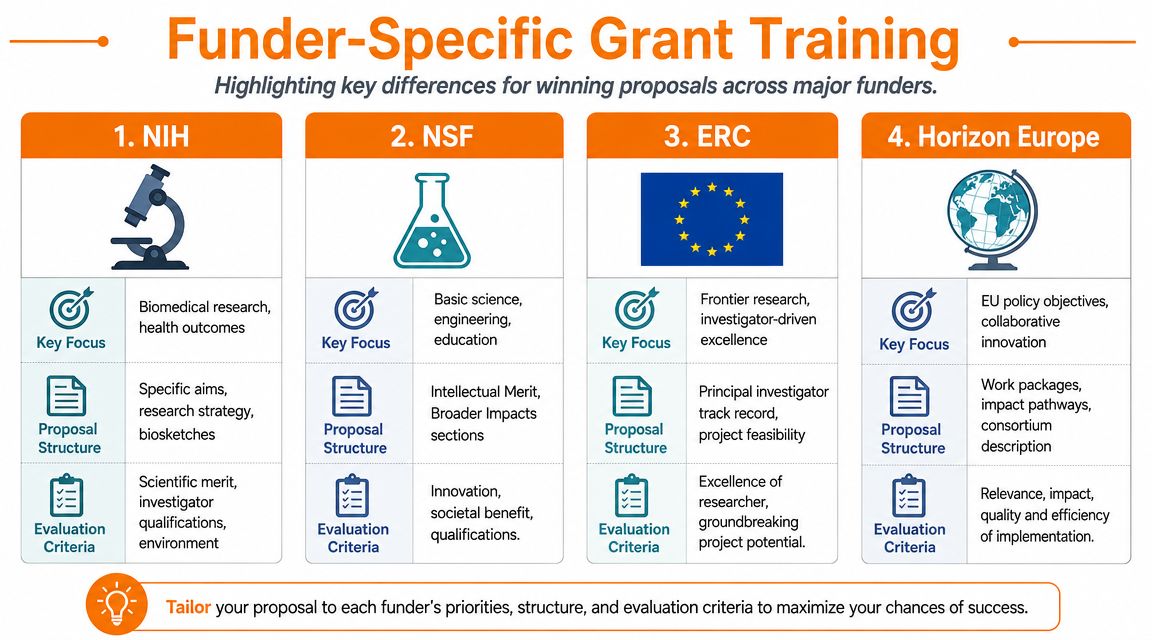
NIH training should emphasize scientific rigor, feasibility, reviewer readability, and internal routing discipline. Applicants often need support not only with the research strategy but also with biosketch consistency, data management expectations, attachments, and platform readiness.
NSF workshops need a different emphasis. Trainers should push participants to integrate intellectual merit and broader impacts early, not bolt one onto the other at the end. The common failure mode is treating broader impacts as a secondary paragraph rather than part of the project's logic.
ERC proposals demand a sharper single-investigator vision. The training challenge is helping applicants articulate a bold, coherent agenda without inflating claims beyond feasibility. Horizon Europe usually requires the opposite muscle. Teams must coordinate across partners, work packages, impact pathways, and implementation details without losing the central argument.
A quick comparison helps facilitators shape drills:
| Funder | Training Priority | Common Workshop Drill |
|---|---|---|
| NIH | Rigor, feasibility, submission readiness | Specific aims review and attachment checklist |
| NSF | Integration of merit and broader impacts | Criteria-mapping exercise |
| ERC | Investigator vision and high-gain framing | Short pitch critique with scope challenge |
| Horizon Europe | Consortium logic and impact structure | Work-package alignment and partner-role mapping |
A useful visual can help orient participants before you move into the drills.
Train for submission readiness not just narrative quality
One of the biggest gaps in current grant proposal writing training is administrative realism. The UNSSC course page on grant and proposal writing highlights a critical gap in most training, namely the lack of focus on funder-specific compliance and administrative workflows. NIH validation changes, for example, can delay submission if mishandled. Many courses still spend their energy on narrative craft while ignoring the system requirements that can trigger rejection before scientific review.
That should change how train-the-trainer programs are built. Every funder-specific unit should include:
- A submission map: registration, validation, institutional approval, and final entry steps
- A compliance checklist: mandatory documents, formatting rules, and recurring administrative hazards
- A role matrix: who owns what across PI, department, central office, and collaborators
- A failure review: examples of avoidable non-scientific errors that derail submissions
A workshop is incomplete if participants can draft a strong narrative but still can't assemble a compliant application package.
Research administrators often become the most important trainers in the room. They can translate sponsor rules into practical sequence, and they can show faculty where the bottlenecks really are.
Integrating AI and Tools Like Proposia into Grant Training
Researchers are already using AI. The practical question is whether your training program is guiding that behavior or pretending it isn't happening.
Where AI belongs in the workflow
The strongest use of AI in grant training is not to “write the grant for you.” It's to speed up less impactful tasks, sharpen structure, and support disciplined review.
Microsoft's 2024 Work Trend Index, cited by ORS Learn Grant Writing found that 75% of knowledge workers are using AI at work, and 78% of users were bringing their own AI tools. For trainers, that means participants are likely already experimenting with AI in drafting, editing, summarizing, and brainstorming. If your workshop ignores that, you leave people to invent their own rules.
A useful training workflow puts AI in bounded roles:
- Call analysis: extracting key requirements, deadlines, and criteria into a checklist
- Idea framing: generating alternative framings for significance, impact, or positioning
- Draft scaffolding: producing outlines or section structures from researcher notes
- Plain-language revision: tightening dense prose so reviewers can follow it
- Red-team prompting: asking the tool to identify weaknesses, unanswered questions, and missing evidence
The human role remains central. Researchers supply judgment, novelty, disciplinary accuracy, confidential context, and final verification. AI can help accelerate a process. It cannot own the intellectual accountability.
The rules trainers need to set
Any workshop that introduces AI should include an explicit governance segment. Participants need rules, not vague cautions.
Start with confidentiality. Researchers should know what they can and can't upload based on institutional policy, sponsor conditions, and the sensitivity of unpublished work. Then address verification. Every factual statement, citation, and methodological description generated or revised by AI must be checked by a human who knows the material.
A basic AI module for grant proposal writing training should cover:
- Approved use cases
- Restricted content
- Human verification steps
- Version control
- Disclosure and policy awareness
One practical way to frame this for faculty is to treat AI as a junior drafting assistant with no subject accountability. It can help organize and challenge. It cannot be trusted with final truth claims.
For institutions updating their workshop materials, this guide to AI grant writing tools in 2025 is a useful reference point for discussing how tool-assisted workflows fit into modern proposal development without replacing expert judgment.
How to Measure the ROI of Your Grant Training
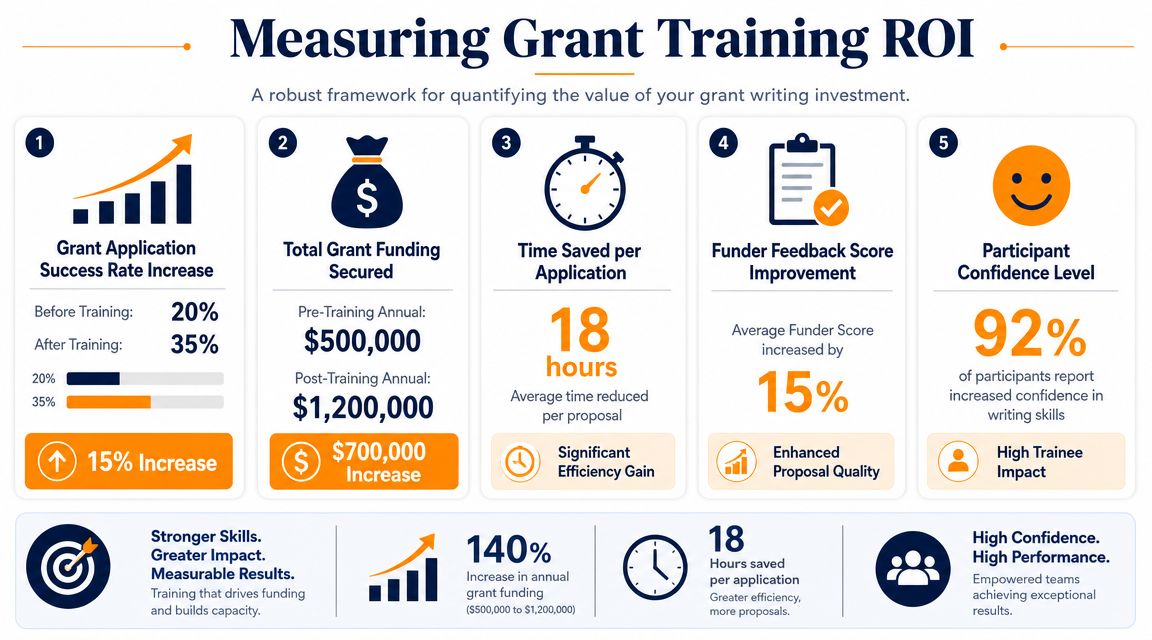
If you only measure attendee satisfaction, you'll miss whether the program changed anything that matters. Good grant training earns credibility when it improves proposal behavior and when you can show that improvement with a serious evaluation plan.
Use benchmarks that reflect reality
Success rates should never be discussed without context. Teams applying to warm funders, renewal pathways, or familiar programs operate under different conditions from teams approaching new sponsors with new ideas.
Funding for Good's analysis of grant writer success rates notes that success rates for established funders can be as high as 80% to 90%, while approaching new funders often yields only 30% to 40% even for excellent applications. That should reshape how you evaluate training. A program serving mostly first-time applicants to new funders should not be judged by the same outcome benchmark as one supporting mature institutional relationships.
So evaluate by portfolio type:
- Existing funder, established program
- Existing funder, expanded program
- New funder, known topic
- New funder, new program area
That avoids one of the most common mistakes in internal reporting, which is treating all submissions as equivalent.
Measure leading indicators before outcomes arrive
Outcomes take time. Proposal decisions may arrive months after training. That doesn't mean you have to wait to know whether the program is working.
Use a layered scorecard. Short-term indicators can tell you whether the training changed process quality before award data comes in.
Consider tracking:
- Opportunity triage quality: Are participants choosing more appropriate calls?
- Draft readiness: Are concept notes and first drafts arriving earlier?
- Review uptake: Are more teams using peer review, mock review, or red-team edits?
- Compliance performance: Are fewer applications hitting last-minute administrative problems?
- Revision behavior: Are participants acting on feedback rather than defending first drafts?
The first sign of training ROI is usually not more awards. It's fewer preventable mistakes.
A simple evaluation framework can work well:
| Timeframe | What to Measure | Why It Matters |
|---|---|---|
| Immediately after training | Confidence in target skills, usefulness of tools, clarity of next steps | Confirms instructional relevance |
| Within one cycle | Number of drafts reviewed, timing of internal submissions, checklist use | Shows behavior change |
| Medium term | Reviewer comments, internal quality ratings, submission volume by fit | Shows proposal quality movement |
| Longer term | Success rates segmented by funder familiarity and proposal type | Shows strategic impact |
The institutions that do this well usually combine central-office records with short participant follow-up surveys and selective interviews. They also run debriefs on both funded and unfunded proposals. That matters because a good training program doesn't just chase wins. It reduces wasted effort, improves internal coordination, and creates a repeatable standard for proposal development.
If you're building a faster, more structured grant development process, PROPOSIA can help your team move from call analysis to draft refinement with a workflow built for real research funding environments. It supports requirement mapping, idea development, iterative drafting, and red-team review across major funders, making it a practical fit for research offices, PIs, and workshop leaders who want grant training tied to actual proposal production.